

Are the Āgamas a school, a collection of sutras, or part of the Buddhist canon? Is Kegon another name for Avataṃsaka? And how does “renunciatory Buddhism” relate to the Japanese schools of Kusha, Jōjitsu, and Ritsu? The infographic accompanying this article brings together names from three different levels of classification. Understanding those levels makes it a useful guide to study.
We will explore each of the eight traditions presented by Gyōnen in The Essentials of the Eight Traditions, using Leo M. Pruden’s English translation. For every school, we will distinguish the course’s approach, the infographic’s textual category, and the actual texts on which the Japanese tradition rests.
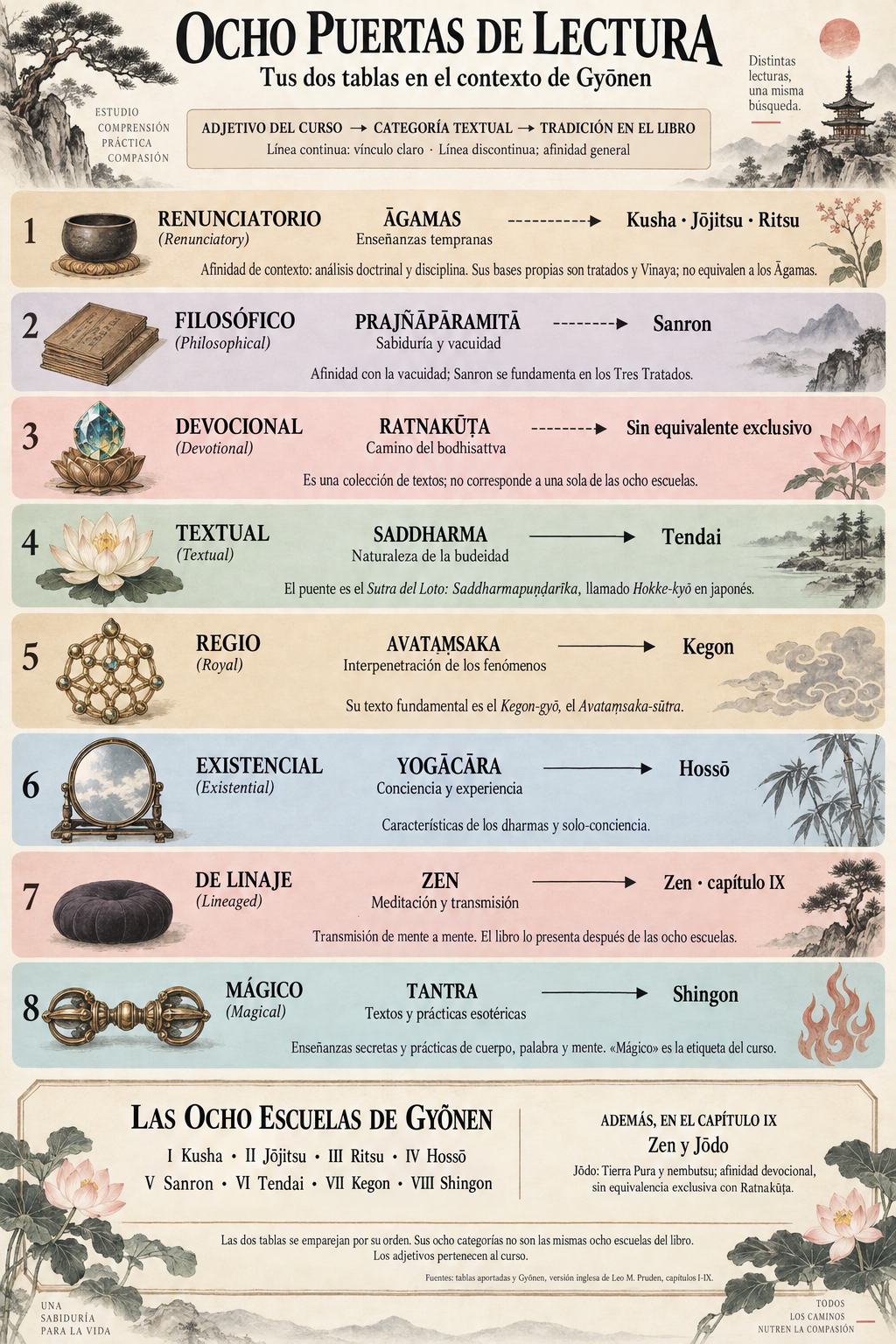
Open and enlarge the full infographic. The illustration retains its Spanish labels; their English equivalents are explained throughout this article. Solid lines indicate clear connections, while dashed lines indicate broad affinities. The image follows the course’s order; this article follows the book’s order.

How to read the three columns
First column: the approach. Renunciatory, philosophical, devotional, textual, royal, existential, lineaged, and magical are the course’s teaching labels. Each highlights an aspect of Buddhist experience. They are not Gyōnen’s names for his schools, nor do they describe each tradition exclusively: a single school can encompass philosophy, devotion, meditation, and ritual.
Second column: the texts or field of teaching. Here we find Āgamas, Prajñāpāramitā, Ratnakūṭa, Saddharma, Avataṃsaka, Yogācāra, Zen, and Tantra. These are not eight categories of the same kind. Some designate collections of sutras; others name a doctrinal movement, a transmission tradition, or a field of literature and practice.
Third column: the Japanese traditions. Kusha, Jōjitsu, Ritsu, Hossō, Sanron, Tendai, Kegon, and Shingon are the book’s eight schools. Gyōnen then adds a chapter on Zen and Jōdo. Eight rows in the image therefore do not amount to eight exact matches with the eight schools.
Before we begin: sutra, sutta, piṭaka, and treatise
Piṭaka means “basket.” The Sanskrit Tripiṭaka and Pali Tipiṭaka designate the “three baskets,” a traditional way of organizing Buddhist teachings. Distinguishing them helps us recognize what kind of text we are reading.
Sūtra Piṭaka: the collection of discourses or teachings. Sūtra is Sanskrit and sutta is Pali; “sutra” is commonly used in English without the diacritic. Vinaya Piṭaka: the rules, procedures, and narratives concerning monastic discipline. Abhidharma Piṭaka: the systematic exposition and classification of doctrine; the Pali form is Abhidhamma. Different Buddhist canons do not contain exactly the same works.
A śāstra is a treatise that develops, analyzes, or comments on a teaching. A treatise is not necessarily a sutra, and having “Abhidharma” in its title does not automatically place it within every school’s canonical Abhidharma basket. The Abhidharmakośa, central to Kusha, is a treatise.
The Āgamas are collections of early discourses belonging to the sphere of the Sūtra Piṭaka. Their major collections, preserved especially in Chinese translation, have numerous parallels in the Nikāyas of the Pali Sutta Piṭaka, although they are not identical copies. These include long and middle-length discourses, discourses grouped by topic, and numerically arranged teachings. Comparing the collections helps us understand how related teachings were transmitted. See SuttaCentral’s reader’s guide.
An accurate way to read the first row is: “The course places the Āgamas under its renunciatory approach; Kusha, Jōjitsu, and Ritsu relate to that broader teaching context, but each has its own textual foundations.” It would be incorrect to identify the Āgamas with the Vinaya, or to treat these three schools as three Japanese names for the Āgamas.
1. Kusha: understanding experience through analysis
The three columns: renunciatory approach → Āgamas as the broader context of early discourses → Kusha. The school’s own textual foundation: Abidatsuma kusha-ron, Vasubandhu’s Abhidharmakośa. The image shows a contextual connection, not a textual identity.
Kusha takes its name from kośa, “treasury,” in the treatise’s title. Its field is the analysis of dharmas, the factors through which experience can be described. Here “dharma” does not mean a separate religion. It refers to an element or factor under examination, such as form, feeling, consciousness, or a mental state.
Why classify experience so carefully? To recognize how it arises and how clinging, defilements, and the causes of suffering operate within it. In an episode of anger, for instance, analysis invites us to distinguish what was perceived, the feeling that arose, the mental reaction, and the resulting behavior. This is a teaching illustration, not a quotation from the treatise.
Its orientation toward liberation helps explain its place under “renunciatory,” but Kusha is also rigorously philosophical. Its central reference is an Abhidharma treatise, not a collection of Āgamas. Gyōnen discusses this tradition in Chapter I.
2. Jōjitsu: examining what we believe exists
The three columns: renunciatory approach → Āgamas as a broad context → Jōjitsu. The school’s own textual foundation: Jōjitsu-ron, Harivarman’s Satyasiddhi-śāstra. Here, too, there is no direct equivalence between the school and the Āgamas.
Jōjitsu examines the teachings of liberation through reflection on the person and on phenomena. In Gyōnen’s account, emptiness plays a decisive role: the self and dharmas are questioned as substantial realities to which one might cling.
This helps explain both its proximity to Kusha and its difference from it. Both engage in doctrinal analysis, but they should not be merged into a single position. Studying the factors of experience and investigating their lack of substantiality are related inquiries that can lead to different arguments.
Chapter II itself records differing interpretations of Jōjitsu’s place in relation to Hīnayāna and Mahāyāna. “Renunciatory” therefore serves as an entry point within the course, not a label that settles its entire doctrinal history. Hīnayāna and Mahāyāna belong to the book’s historical vocabulary; Hīnayāna should not automatically be equated with present-day Theravāda.
3. Ritsu: giving practice a concrete form
The three columns: renunciatory approach → affinity with the early-teaching context represented by the Āgamas → Ritsu. The school’s own textual foundation: the Vinaya, especially the Shibun-ritsu, the Dharmaguptaka Vinaya. Here the distinction between baskets is essential: Āgamas = discourses; Vinaya = monastic discipline.
Ritsu concerns precepts, ordination, and communal life. It does more than enumerate prohibitions. Gyōnen distinguishes precepts that stop harmful actions from those that prescribe beneficial practices, alongside procedures for maintaining communal life and resolving disputes.
Its central question can be expressed as follows: how does a teaching become something we can enact through body, speech, and mind? Discipline establishes conditions for meditation and wisdom. A precept, from this perspective, is more than an external rule: it helps form a way of living.
Chapter III also presents interpretations linking the Vinaya with Mahāyāna and the threefold pure precepts: avoiding evil, cultivating good, and benefiting beings. Ritsu cannot be confined to a simple opposition between renunciation and compassion. The image connects it contextually with the Āgamas; the book grounds it in the Vinaya.
4. Hossō: investigating how we know
The three columns: existential approach → Yogācāra → Hossō. The school’s own textual foundation: a body of sutras and treatises, including the Jō-yuishiki-ron and the Yuga-ron. Yogācāra is a movement of doctrine and practice, not a single sutra or a fourth basket of the Tripiṭaka.
Gyōnen explains Hossō’s name through the “characteristics of the dharmas.” The tradition examines consciousness and how what we know takes shape. Hence its association with consciousness-only, also expressed as “cognizing-only” in Pruden’s translation.
An everyday example can introduce its concerns: two people take part in the same conversation and leave with different interpretations. Perception, memory, habits, and expectations shape their experience. This example does not exhaust the doctrine, but it shows why the act of knowing deserves examination alongside what we believe we know.
“Existential” is the course’s label for this field. It does not mean that Hossō is a Japanese version of modern existentialism. The Yogācāra–Hossō connection is doctrinally clear; the Western label is a teaching aid. See Chapter IV.
5. Sanron: emptiness as a critique of clinging
The three columns: philosophical approach → Prajñāpāramitā → Sanron. The school’s own textual foundation: the Three Treatises, Chū-ron, Hyaku-ron, and Jūni-mon-ron. Its connection with Prajñāpāramitā is an important doctrinal affinity, not an equivalence between a collection and a school.
Prajñāpāramitā means “perfection of wisdom” and names a family of Mahāyāna sutras. Sanron, whose name means “Three Treatises,” develops the critical inquiry associated with Nāgārjuna and Āryadeva. Gyōnen also introduces the Daichido-ron, a commentary related to Prajñāpāramitā literature, when explaining a grouping of four treatises.
Emptiness should not be hastily understood as “nothing exists.” The point is to question whether things possess an independent, self-sufficient existence. Even a sound idea can become another fixation if we turn it into an absolute that we no longer examine.
Sanron accordingly analyzes positions and distinguishes levels of truth rather than simply offering a definition to memorize. The image places this work under “philosophical,” but its purpose remains connected with freedom from clinging. The book develops this account in Chapter V.
6. Tendai: reading the teachings through the Lotus Sutra
The three columns: textual approach → Saddharma, understood here through the Lotus Sutra → Tendai. The school’s own textual foundation: the Saddharmapuṇḍarīka-sūtra, known in Japanese as Hokke-kyō. “Saddharma” means the true or correct Dharma; on its own, it is not invariably the abbreviated title of one particular book.
The precise connection in our image runs through the Lotus Sutra. Gyōnen presents it as Tendai’s fundamental scriptural authority, through which other teachings are evaluated and organized. This does not mean the tradition studies that sutra alone: Chapter VI emphasizes its use of many scriptures and commentaries.
Tendai addresses a question of interpretation: how can different teachings be understood without assuming either that they all say exactly the same thing or that they contradict one another beyond reconciliation? Its classifications consider the capacities of those receiving the teachings and the ways those teachings lead toward awakening.
The label “textual” highlights this interpretive work. Yet Tendai is not simply a matter of reading books: meditation and insight are integral to its practice. The sutra provides guidance for understanding and practice, rather than merely supplying inspirational statements.
7. Kegon: each phenomenon in relation to all the others
The three columns: royal approach → Avataṃsaka → Kegon. The school’s own textual foundation: the Avataṃsaka-sūtra, called Kegon-gyō in the book. This is one of the infographic’s clearest textual connections: the tradition takes its name from its foundational scripture.
Kegon develops a vision of the interpenetration of phenomena. Each event can be understood in relation to a network of conditions extending beyond it. As an illustration, a cup of tea brings together water, soil, climate, cultivation, labor, vessels, and people. What appears to be an isolated thing points toward many relationships. Kegon doctrine takes this interdependence much further than the example can convey.
Interpenetration does not mean that all distinctions disappear. The question is how to understand both the particularity of each phenomenon and its relationship with the whole. Chapter VII presents this tradition’s classifications and its account of the perfect teaching.
“Royal” is the course’s label. It can evoke the scope and magnificence of the sutra’s universe, but it should not be mistaken for a translation of Kegon or a claim that the school’s doctrine consists in defending monarchy. The firm connection in this row is Avataṃsaka–Kegon.
8. Shingon: body, speech, and mind in esoteric practice
The three columns: the approach called magical by the course → Tantra → Shingon. The school’s own textual foundation: esoteric scriptures and traditions, with the Dainichi-kyō as a central reference. “Tantra” here names a broad textual and practical field, not a single book whose name translates as Shingon.
Shingon means “true word,” an expression associated with mantra. In Chapter VIII, Gyōnen presents the secret teachings and the relationship between awakening and practices of body, speech, and mind. Ritual gestures, recitation, and contemplation are integrated into a path of transformation.
The term “magical” requires particular care. In our chart it reproduces the course’s terminology; a more precise description of Shingon’s field would be esoteric and ritual Buddhism. Reducing it to the acquisition of powers or extraordinary results would obscure its relationship with wisdom and Buddhahood.
The connection shown in the image is useful as an orientation, provided it is not extended into a claim that all tantra belongs to Shingon. Other Buddhist traditions also have tantric teachings. Here we are locating one Japanese tradition within that wider field.
The rows without a single equivalent: Ratnakūṭa, Zen, and Jōdo
After our tour of the eight schools, two rows in the image still need separate explanation. Their presence makes clear why the two systems of classification cannot be matched one to one.
Devotional → Ratnakūṭa → no exclusive Japanese school. Ratnakūṭa is a collection of Mahāyāna sutras addressing various aspects of the bodhisattva path. It does not itself constitute one of Gyōnen’s eight schools, and devotion does not exhaust its contents. One glimpse of the collection’s diversity is The Question of Maitreya, translated by 84000. This row remains useful without inventing an equivalent school.
Lineaged → Zen → Zen. The same word appears in two columns because the list combines different kinds of categories. Zen is a tradition of practice and transmission, not a collection of sutras directly comparable to the Āgamas. Gyōnen presents it in Chapter IX, after the eight traditions, emphasizing mind-to-mind transmission and seeing into one’s own nature. “Lineaged” is the course’s term for this emphasis on lineage.
Where does Jōdo belong? It also appears in Chapter IX. Its orientation toward the Pure Land and the practice of nembutsu suggest an affinity with the devotional approach. This does not justify writing “Ratnakūṭa = Jōdo.” A collection of sutras and a practice tradition are not interchangeable, even when they share themes and connections.
A reference chart for returning to the map
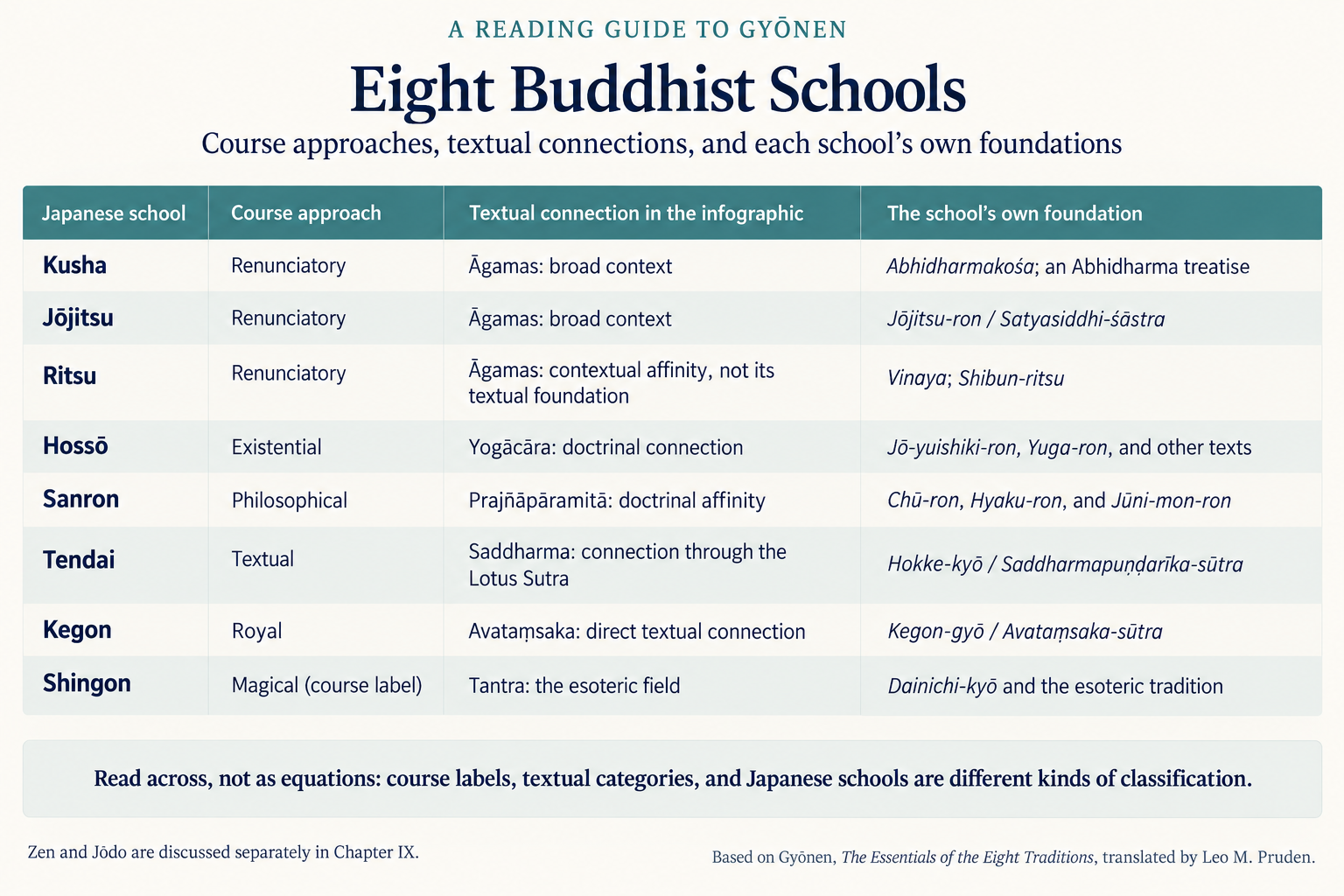
| Japanese school | Course approach | Textual column in the image | The school’s own foundation |
|---|---|---|---|
| Kusha | Renunciatory | Āgamas: broad context | Abhidharmakośa; an Abhidharma treatise |
| Jōjitsu | Renunciatory | Āgamas: broad context | Jōjitsu-ron / Satyasiddhi-śāstra |
| Ritsu | Renunciatory | Āgamas: contextual affinity, not its textual foundation | Vinaya; Shibun-ritsu |
| Hossō | Existential | Yogācāra: doctrinal connection | Jō-yuishiki-ron, Yuga-ron, and other texts |
| Sanron | Philosophical | Prajñāpāramitā: doctrinal affinity | Chū-ron, Hyaku-ron, and Jūni-mon-ron |
| Tendai | Textual | Saddharma: connection through the Lotus Sutra | Hokke-kyō / Saddharmapuṇḍarīka-sūtra |
| Kegon | Royal | Avataṃsaka: direct textual connection | Kegon-gyō / Avataṃsaka-sūtra |
| Shingon | Magical, in the course’s terminology | Tantra: the esoteric field | Dainichi-kyō and the esoteric tradition |
When returning to the image, we can ask three questions: which aspect of practice is being highlighted, what kind of text or teaching is named, and which Japanese tradition studies it—and how? Following those questions allows us to recognize connections without forcing distinct categories into identical meanings.
Sources and approach
The principal source is Gyōnen, The Essentials of the Eight Traditions, translated into English by Leo M. Pruden, Numata Center for Buddhist Translation and Research, 1994: Chapters I–VIII for the eight schools and Chapter IX for Zen and Jōdo. This article is an introductory explanation, not a verbatim translation or reproduction of the book. See the publisher’s description of the edition.
The approach labels and their pairing with textual categories come from the two course charts, read in the order supplied. Their connections with the schools form a comparative guide; differences of category and partial relationships are explicitly identified. SuttaCentral was consulted for the distinction between discourse collections, and the linked 84000 presentation for Ratnakūṭa. The infographic was created for this study with the assistance of artificial intelligence.
Deja una respuesta