

Reading guide to edition 29 of the BESA Atlas, reviewed on October 3, 2026.
An atlas of Buddhist cosmology requires us to learn how to look. A mountain may indicate the center of a world; a sequence of names, a classification of realms of existence; a number, an operation of multiplication; a luminous line, a relationship between Buddha-fields. Although these elements share a screen, they do not make the same kind of claim. This introduction offers a method for exploring the BESA Atlas and understanding what each of its images enables us to know.
The starting point is W. Randolph Kloetzli’s Buddhist Cosmology: Science and Theology in the Images of Motion and Light. The atlas visually organizes materials and interpretations from this work through five plates, a three-dimensional model of the Cakravāla, and documentary entries. Its most productive use involves alternating between three activities: observing a structure, selecting a relationship, and returning to the passage that supports it.
Open the resource: BESA Atlas of Buddhist Cosmologies. For a further discussion of the book, see the Spanish-language article Medir el universo recorrer el camino.
Abstract and Approach
This article offers a guided reading of the spatial, classificatory, meditative, and soteriological relationships presented in the BESA Atlas. It explains the functions of the Cakravāla’s plan and sectional views, the organization of the heavens, the two dhyāna sequences preserved in Kloetzli’s account, the multiplication of worlds in sāhasra cosmology, and relationships between Buddha-fields in asaṃkhyeya cosmology. Navigation instructions and figures extracted from the resource accompany the discussion. Its methodological premise is that an image becomes intelligible when readers can identify both the relationship it represents and its documentary basis.
Keywords: Buddhist cosmology; Kloetzli; Cakravāla; dhyāna; samādhi; buddhakṣetra; digital atlas; scholarly visualization.
- 1. Distinguishing the Source, the Explanation, and the Image
- 2. The Cakravāla in Plan: Finding Your Bearings in a World
- 3. The Section: Heavens, Realms, and the Limits of Verticality
- 4. Dhyāna: Comparing Two Sequences Without Merging Them
- 5. Sāhasra: Multiplication and Cosmic Time
- 6. Asaṃkhyeya: Fields, Directions, and the Efficacy of Light
- 7. Motion and Light: What the Final Plate Compares
- 8. Exploring the Three-Dimensional Model
- 9. A Worked Example: Consulting Tuṣita
- 10. A Study Itinerary and Questions to Keep in Mind
- Brief Glossary
- Reading Through the Image and Returning to the Text
- References and Figure Sources
1. Distinguishing the Source, the Explanation, and the Image
The atlas examines Buddhist cosmology through Kloetzli’s interpretation. This qualification defines its scope: the book brings together materials from different sources, compares traditions, and develops interpretations of its own. On p. 31, for example, it distinguishes reconstructions of the world based on the Pāli Abhidhamma from the Abhidharmakośa materials used for vertical cosmology. The note to figure 2, p. 33, explicitly identifies the chart as composite and points to variations in the names and numbers of the heavens. The figure should therefore not be mistaken for a uniform taxonomy shared by all Buddhist schools.
The labels A, B, and C help preserve this distinction. A identifies an explicit statement by Kloetzli, accompanied by a reference; B, an explanation or reconstruction developed by BESA on the basis of the cited materials; and C, a representational decision, such as color, spacing, or the path of an animation. These labels identify relationships to documentation. They are neither a scale of aesthetic quality nor an automatic guarantee of scholarly consensus.
A single entry may contain all three levels. A heaven’s appearance in figure 2 is a documentary fact; explaining its place within a larger grouping requires interpretation; positioning its name beside a vortex requires a graphic decision. Likewise, an explicit thesis advanced by the author may receive an A label while remaining open to debate. Whether a claim is explicit and whether other scholars accept it are separate questions.
The explanatory text, printed-page reference, and visual-decision section should be read together. When an entry indicates that academic approval is pending, it describes the atlas’s review status. Locating a passage makes a reference checkable; validating its translation, scope, and representation requires a further judgment.
2. The Cakravāla in Plan: Finding Your Bearings in a World
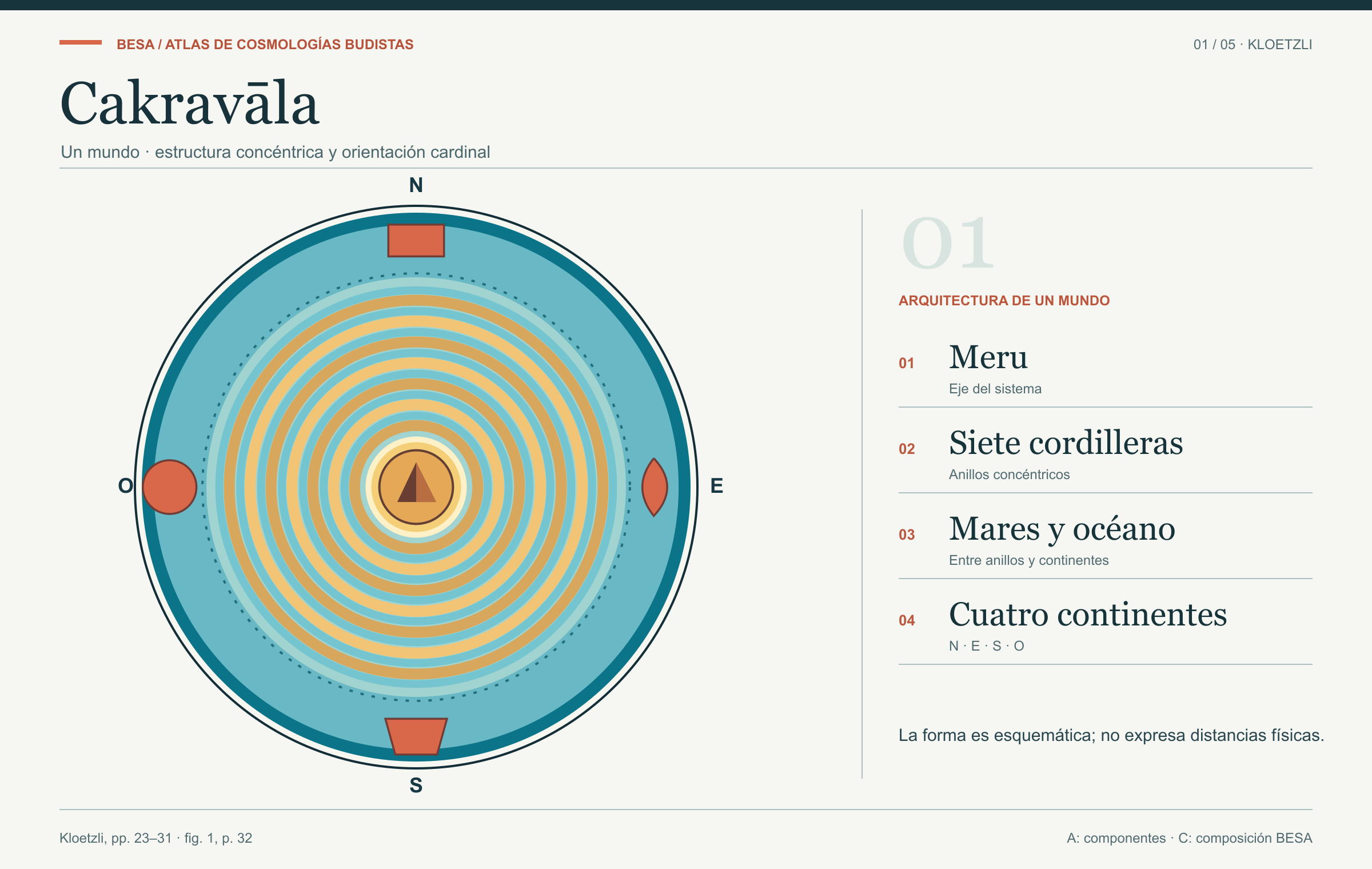
The Cakravāla is a single world system. To begin, open the plates, select “01 Cakravāla,” and choose the plan view. This view answers a specific question: how are the components distributed around Meru? Its vocabulary is concentric and directional: center, rings, waters, continents, and outer boundary.

Begin with Meru, also called Sumeru. Then follow the seven mountain rings and the intervening seas. Finally, identify the four continents and the system’s outer wall. The plan establishes north, east, south, and west so that relationships remain recognizable as the view changes. Jambudvīpa corresponds to the south; Uttarakuru, to the north; Pūrvavideha, to the east; and Aparagodānīya, to the west. The entries allow readers to examine the characteristics and variants discussed by Kloetzli (pp. 24–29).
The visible sizes and shapes help distinguish elements and clarify their relative positions. They do not, by themselves, establish a metric scale. Although the sources provide measurements in yojanas, the atlas’s geometry adopts proportions that remain legible. A distance between two figures on the screen should not be converted into a historical measurement without consulting the relevant information and its context.
A useful first exercise is to select Jambudvīpa and read its entry. Kloetzli connects it with the Buddha’s biography and places the hells beneath that continent in the scheme he describes (p. 28). This gives meaning to its position in the 3D model: the lower region is not simply an undifferentiated underground extending beneath the entire disc. The documented association is more specific than the visual impression of being “below.”
3. The Section: Heavens, Realms, and the Limits of Verticality
Now switch to the sectional view. This introduces a hierarchy of realms of existence. Yet the hierarchy brings together different kinds of relationships. The base of the drawing locates Meru and the waters, while its upper strata organize doctrinal groupings. The vertical distance between labels does not correspond to a uniform physical distance.

Kāmadhātu, the realm of desire, encompasses more than its six deva heavens: it also includes the human world and other destinies represented in the chart. The celestial group comprises Caturmahārājakāyika, Trāyastriṃśa, Yāma, Tuṣita, Nirmāṇarati, and Paranirmitavaśavartin. Kloetzli associates the first two with Meru: the gods of the Four Great Kings with its terraces, and Trāyastriṃśa with its summit (pp. 29 and 33). The remaining names in the model serve as reference points for consultation; their graphic positions do not establish physical coordinates.
Rūpadhātu, the realm of form, contains seventeen heavens in the chart used by the atlas. They are distributed among four dhyāna groups: three, three, three, and eight. Within the fourth group, the five upper entries, from Avṛha to Akaniṣṭha, form the subset of the Pure Abodes. Both relationships must be preserved: belonging to the fourth dhyāna group and belonging to this subset are not equivalent conditions (pp. 29–30 and figures 2–3, pp. 33–34).
Arūpyadhātu, the formless realm, requires a different reading. In Kloetzli’s presentation of the Kośa, its four attainments do not constitute abodes physically positioned above Akaniṣṭha. Their superiority is explained in terms of concentration, not as a higher location in space (p. 30). The atlas therefore retains an indication that they have no spatial location. When opening the abstract study of this realm, its figures and transitions should be understood as aids to consultation, not as material bodies or spheres.
Nor should nirvāṇa be added as the building’s final floor. In this context, the question of liberation cuts across relationships between practice, rebirth, and detachment from the realms. The vertical arrangement helps organize the presentation, but it does not turn liberation into a place that can be reached by moving the camera.
For the hells, the immediate documentary basis is precise and limited: Kloetzli mentions eight hot and eight cold hells beneath Jambudvīpa (p. 28). The model’s chambers, materials, and separations develop this information through BESA’s decisions. Consulting the entry makes it possible to recognize where the documented location ends and the visual elaboration begins.
4. Dhyāna: Comparing Two Sequences Without Merging Them
The second plate provides one of the atlas’s most useful exercises in critical reading. Here, dhyāna refers to the four meditative absorptions around which the form heavens are organized. However, their relationship to the extent of worlds is not expressed uniformly in the passages examined. Figure 4, p. 35, and the text on p. 60 present different sequences.

| Dhyāna | Figure 4, p. 35 | Text, p. 60 |
|---|---|---|
| I | One four-continent universe | 1,000 Cakravālas |
| II | 1,000 worlds | 1,000² worlds |
| III | 1,000² worlds | 1,000³ worlds |
| IV | 1,000³ worlds | Without measure |
Read each row horizontally before following the columns downward. This makes clear that the same ordinal does not have the same scope in both sequences. The atlas preserves the difference and allows readers to return to the corresponding references. The expression “without measure” does not authorize the introduction of a fourth exponent, as though the book had stated 1,000⁴.
A crucial distinction follows for navigating the atlas as a whole: cosmological grouping, meditative attainment, and condition of rebirth are relationships that require explanation. The existence of correspondences does not justify describing each heaven as simply a psychological state. Nor does the viewer’s thirteen-stop itinerary constitute a meditative practice: it is an editorial sequence designed to facilitate study of the model.
5. Sāhasra: Multiplication and Cosmic Time
In the third plate, the Cakravāla becomes a unit of aggregation. The sequence 1, 1,000, 1,000², and 1,000³ expresses a multiplication of world systems. In the numerical interpretation represented here, trisāhasramahāsāhasralokadhātu refers to an aggregation of one billion worlds. Kloetzli explicitly discusses other translations and interpretations of the term (pp. 60–63); the atlas presents one documented configuration rather than resolving all historical variants through a single number.

Use the scale controls to follow the operation of multiplication, rather than counting the small symbols as though they depicted every world in existence. The image abbreviates a quantity through notation. The dhyāna associations shown on this plate follow the passage on p. 60 and should be read alongside the comparison on the preceding plate.
The lower register introduces another variable: time. The phases of creation, duration, dissolution, and the dissolved state organize the cosmic cycle described by Kloetzli. His account distinguishes these four phases and the intermediate periods composing them (p. 74). Changing phase allows readers to study a succession; changing scale allows them to study an aggregation. The two operations are related within the book’s argument, but they are not interchangeable.
The sequence of destructions also requires a temporal reading: seven destructions by fire followed by one by water, repeated seven times; then seven by fire and a final destruction by wind. The total is fifty-six by fire, seven by water, and one by wind (p. 75). The plate’s marks make this order visible. They represent neither a clock of observed durations nor an animation of contemporary physical processes.
6. Asaṃkhyeya: Fields, Directions, and the Efficacy of Light
The fourth plate changes the question. A buddhakṣetra is a Buddha-field: its significance encompasses the Buddha’s presence, teaching, and the possibilities for beings’ transformation. In the cosmology of innumerables, these fields are articulated across the ten directions. The diagram presents eight orientations in plan and additionally indicates zenith and nadir. These ten directional references should not be confused with an inventory of only ten worlds.

Select the options for vision, hearing, access, and merit in turn. Each directs attention to a different relationship. In the narratives analyzed by Kloetzli, the Buddha’s entry into samādhi and emission of rays make it possible for assemblies to see one another, hear the teaching, and participate in relationships between fields (pp. 94–109). Light has narrative and soteriological efficacy; the drawing uses connections to make this activity intelligible.
The distinction matters: on p. 109, Kloetzli distinguishes the illumination of already existing Buddhas from the production of images or transformation Buddhas, nirmāṇabuddhas. Not every ray signifies creation, and not every multiplicity involves the same mechanism. A line joining two fields may represent visibility or access without asserting that one has materially emanated from the other.
The indication “Seeing ≠ rebirth” deserves particular attention. On pp. 128–129, Kloetzli raises precisely the problem of moving from visual access to rebirth in other fields and explores possible solutions. The atlas allows readers to examine this question without turning the author’s reconstruction into a fully settled mechanism. The distinction also concerns Pure Lands: Sukhāvatī should not be added as the highest heaven in a tower built around Meru.
7. Motion and Light: What the Final Plate Compares
The fifth plate brings together pairs for comparison: time and space, motion and light, measure and innumerability, an extended path and access, among others. It synthesizes Kloetzli’s interpretation. These contrasts describe two dramas of salvation: one gives particular importance to the journey and its duration; the other emphasizes the plurality of Buddhas and the efficacy of their activity (pp. 134–137).

The expressions self-power and other-power appear within this framework, corresponding to the Spanish renderings “poder propio” and “poder de otro.” They should be read as comparative categories in the argument, without reducing them to individualism and passivity. Another part of the author’s proposal is to understand the Cakravāla as an abbreviation of sāhasra cosmology for the monastic vocation, and Pure Land cosmologies as simplifications of asaṃkhyeya for Mahāyāna devotional traditions (pp. 136–137).
The usefulness of this plate depends on preserving that attribution. It presents a historical-comparative thesis, not an exhaustive and indisputable division of Buddhism. Returning to the earlier plates, readers can ask what this comparison clarifies and which variants or tensions require further investigation.
8. Exploring the Three-Dimensional Model
Open “Cakravāla” from the main navigation or use the option to open the 3D model from its plate. The model allows readers to examine relationships compressed in a plan: Meru’s elevation, the arrangement of the surrounding world, and the lower region associated with Jambudvīpa. The camera adds viewpoints; labels and entries provide documentary identification.

- Enlarge the view. Use the expand-viewer icon. Full-screen mode occupies the screen when the browser permits it. On a narrow screen, the view-controls button reveals the collapsed tools; returning to the atlas closes the expanded view.
- Find your bearings. Choose the concentric, vertical-section, or layers view according to whether you wish to study the whole system, its vertical organization, or the celestial groups. Orbit rotates the camera; pan changes the framing. The zoom controls move closer and farther away. On touch devices, use the available gestures and visible buttons to retain precise control.
- Choose a region. The model’s menu offers heavens, continents, Meru, and hells. The selectors establish the topic; the heaven list allows you to choose a particular entry within its group.
- Retrieve a selection. Its name remains in the selection bar even when the label disappears because of the angle or framing. Centering the selected region brings it back into focus; the book icon opens its entry. Spatial centering is disabled for realms without a spatial location.
- Control movement. The movement controls allow you to alternate between dynamic observation and still reading. The heaven-diagram control fixes the diagrammatic presentation. When exploring with a pointer, highlighting helps connect a name with its marker; for sustained consultation, select the topic and open its entry.
- Return to the whole. The world-overview control restores the global view. The previous-view control returns to a camera position recorded during exploration; resetting the camera provides another way to recover the framing.
The luminous helix requires a specific interpretive caution. Its shape, speed, continuity, and visible axis belong to BESA’s visual elaboration (C). They do not represent a documented physical trajectory of beings or a sequence of meditative states described by Kloetzli in that geometry. Nor should the light in this three-dimensional effect automatically be identified with all the functions of rays examined in asaṃkhyeya cosmology. A visual resemblance between two sections does not establish doctrinal identity.
Labels may shift to avoid overlapping or disappear when their anchor point falls outside the frame. Thin lines connect displaced names to their markers. To learn about an element, it is more reliable to use the selection and its entry than to assign significance to the incidental position of its text on the screen.
9. A Worked Example: Consulting Tuṣita
In the model’s menu, select the heavens, retain the group of six desire heavens, and open the heaven list. Choose Tuṣita. Its entry identifies it as the fourth heaven in the group and provides links to related entries. You can also open Tuṣita’s entry directly in the atlas.

First read the name, its translation, and its place within the group. The brief explanation notes that Tuṣita still belongs to Kāmadhātu; its position does not make it a heaven of the four dhyānas of Rūpadhātu. Then consult the documentary basis: figures 2 and 3, pp. 33–34, allow the enumeration and glosses to be checked. On p. 29, Kloetzli also describes Tuṣita’s relationship to the bodhisattva’s birth immediately preceding his birth as a Buddha in Jambudvīpa.
Now examine the letters. The brief explanation appears as B because it articulates BESA’s reading. The classification of the original entry displays A for the documented information. The visual-decision section identifies C for the representation of the name and its marker in the model. The coexistence of all three letters makes clear what is being assessed in each paragraph.
The expanded academic reading opens a fuller discussion where one is available. The interpretive-limit section specifies which inferences should be avoided. Links to principal relationships help compare related entries without implying that adjacent buttons indicate doctrinal identity. Close the entry to return to the viewer, and use the world overview whenever you wish to restore the broader context.
Entries include a space for observations and an action for copying a comment. The interface states that the comment is not saved on the site: typing there does not amount to submitting a correction to the team. To communicate an observation, copy the text and retain the view’s link. A useful review identifies the claim, its page reference, and the reason for questioning it.
10. A Study Itinerary and Questions to Keep in Mind
For a first visit, begin with the plan and section, consult a particular entry, and then move to the model. The Dhyāna plate subsequently prepares the reading of Sāhasra; Asaṃkhyeya introduces a different organization of relationships; and the final comparison allows a return to the whole. This order helps readers recognize when the image’s language changes.
The 3D tour offers thirteen stops: the whole world, Meru, Jambudvīpa, mountain ranges and seas, hot hells, cold hells, the world’s supports, desire heavens, the four dhyāna groups, and the study of what has no spatial abode. The selector allows you to jump between stops; the previous and next controls follow the editorial order, and the book icon opens the stop’s source entry. These thirteen stops are a pedagogical organization of the visit, not a traditional enumeration of thirteen levels.
The “2D + 3D” option on the Cakravāla plate and the viewer’s 2D reading option allow comparison between the model and its diagrammatic representation. On narrow screens, switching between readings preserves more space than displaying both together. For a shared discussion, use the control that copies the current view’s link: it preserves the reading context better than a generic reference to “the upper part.” Saved camera positions belong to the browser being used and should not be assumed to accompany every link.
The ES/EN selector switches between Spanish and English. Technical terms remain reference points, while their glosses should be read as contextual translations. If an asterisk or provisional spelling appears, consult the relevant note: the marker keeps an editorial issue visible. Plates can be downloaded as PNG or SVG files; static images preserve the selected composition but not its interactive actions.
- What kind of relationship am I seeing? Location, inclusion, classification, multiplication, temporal sequence, or access between fields.
- What does the source actually claim? A documented name does not automatically validate the distance, color, or movement used to represent it.
- Am I confusing practice with a destiny of rebirth? Check how dhyāna, realm of existence, and rebirth are related in the particular entry.
- Can I return to the passage? Retain the printed-page reference, figure number, and link to the selection.
- What remains open? An interpretation by the author or a decision by BESA may require discussion even when the interface functions correctly.
Brief Glossary
| Term | Use in this guide |
|---|---|
| Cakravāla | A single world system; a cosmographic unit that may enter into larger aggregations. |
| Dhātu | Realm or domain; its translation depends on context and does not, by itself, imply a material layer. |
| Dhyāna | Meditative absorption; in the charts examined here, it organizes the four groups of form heavens. |
| Samādhi | Concentration or collectedness; its forms and agents must be distinguished in each passage. |
| Brahmaloka | A designation Kloetzli applies collectively to the seventeen form heavens on p. 29; Brahmā’s particular location requires a further distinction. |
| Kalpa | A cosmic period; its function and divisions depend on the cycle being described. |
| Buddhakṣetra | Buddha-field, considered in relation to presence, teaching, and salvific activity. |
| Sāhasra / asaṃkhyeya | Thousands / innumerables: designations for the two cosmological constructions being compared. |
| Soteriology | Reflection on liberation and the conditions, practices, or powers associated with it. |
Reading Through the Image and Returning to the Text
A scholarly atlas makes visible relationships that sequential reading may leave dispersed. The plan provides orientation; the section distinguishes groupings; numerical sequences compare scales; and connections make it possible to examine different modes of access. Interaction adds the ability to change viewpoint while maintaining a direct connection with the entries.
This capacity demands a discipline of reading: follow the relationship represented, recognize the decision that makes it visible, and check the claim supporting it. The best outcome of a visit is not to have tried every control, but to be able to formulate a more precise question about the world, the path, or the Buddha’s power, and to know where to seek its basis.
References and Figure Sources
Kloetzli, W. Randolph. Buddhist Cosmology: Science and Theology in the Images of Motion and Light. Delhi: Motilal Banarsidass, 1983; reprint consulted, 1989. References in this article correspond to the book’s printed pages, not to image numbers in the digital file.
BESA. Atlas of Buddhist Cosmologies According to Kloetzli, published edition 29, consulted on October 3, 2026. Open the atlas. Figures 1–6 were extracted from the resource’s plates and converted to PNG; figures 7–8 are screenshots of its interface. All show BESA’s visual elaborations: they are not facsimile reproductions of the book’s figures. The original Spanish-language figures have been retained in this English translation.
Methodological note. The principal passages and charts cited in this guide were checked against the PDF of the 1989 reprint, and the published interface was explored. References to the Kośa and other Buddhist sources follow Kloetzli’s presentation; they do not constitute an independent consultation of their original editions. Navigation instructions refer to edition 29 and may require adjustment if the interface changes. This article accompanies a resource undergoing academic review.
Deja un comentario